 Wisata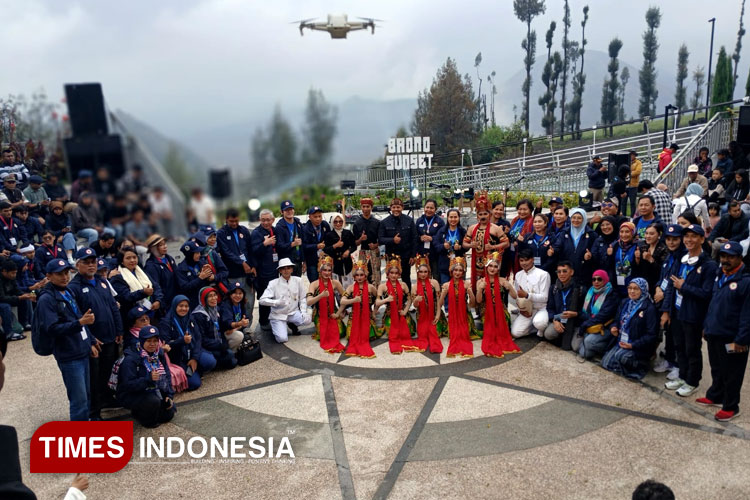
TIMES TUBAN, PROBOLINGGO – By late afternoon, the slopes of Seruni Point, Sukapura, Probolinggo, East Java (6/12/2025), were already folding into mist. A cold wind slid down from the caldera, threading through scarves and thick jackets worn by visitors who had climbed more than two thousand meters above sea level to watch the sun fall behind Bromo’s rugged rim.
The chill didn’t deter them. If anything, it heightened the sense of anticipation.
Shortly after 3 p.m., as the sun broke through a thin veil of clouds, the ninth edition of Bromo Sunset Music and Culture opened with the steady pulse of Tengger drums. The stage—a simple platform carved into the amphitheater’s natural contours—framed a horizon splashed in amber and violet, colors that would shift throughout the evening like a slow-moving performance of their own.
This year’s event, hosted by Probolinggo’s Youth, Sports, and Tourism Office, arrived with an unexpected twist. Not only did it mark the annual cultural showcase, it also coincided with the Regional Leadership Forum of KAPPIJA 21, drawing nearly 150 young leaders from across ASEAN and Japan.
On the stone bleachers sat delegates from Cambodia, Thailand, Myanmar, Malaysia, Vietnam, Timor Leste, Japan, and Indonesia—some first-time visitors to Bromo, others returning to a familiar symbol of Indonesia’s volcanic heartland. They mingled easily with local residents, their conversations blending into the hum of the highland wind.
For a moment, Seruni Point felt like a crossroads of nations suspended in cloud.
A Mountain Turned Into a Stage
The opening performance belonged to a troupe of young Probolinggo dancers whose Tengger choreography—fluid, grounded, reverent—paid homage to the mountain’s heritage. Their movements echoed rituals long held by communities living in Bromo’s shadow.
Delegates watched intently. Phones were raised, though slowly, almost carefully, as if mindful not to break the rhythm of the landscape.
Then the tone shifted. Sunshine Band, a local favorite, brought a burst of cheer that sent pockets of laughter across the amphitheater. Delegates from Myanmar swayed lightly; those from Thailand clapped along, searching for the beat before finding it.
But the crowd’s center of gravity settled on Nabila Putri Maharani, a young singer from Probolinggo whose clear, surprisingly mature voice carried easily across the plateau. When she performed “Probolinggo Paradise,” a song penned by Probolinggo Regent dr. Muhammad Haris (Gus Haris), the applause felt unusually unanimous—an instinctive reaction rather than a polite one.
“She’s extraordinary,” murmured Yoshimasa Sumiya of Japan, holding his phone still as if afraid to disrupt the moment.
Nearby, fellow young singer Viskah Rasyid added a softer note to the evening, her voice weaving into the increasing cold as temperatures dipped sharply.
A Ceremony in the Fog
As the sun edged lower, the mist thickened—first as a gentle curtain, then as a sweeping veil that wrapped around the amphitheater. Under this shifting canopy, Dr. Haris stepped forward to lead a symbolic ceremony naming delegates as “Pemuda Lintas Negara Sahabat Alam Probolinggo” (International Youth Friends of Probolinggo’s Nature).
Representatives emerged one by one: Japan’s Makoto Sumiya and Michiko Nakayama; Malaysia’s Azizi Bin Hashim and Rozita Binti Joned; Myanmar’s Tin Maung Cho and San Dar Win; Thailand’s Pornchanok Khamnna and Dr. Narathpong Udomsri; and dozens of Indonesians from Aceh to East Java.
They accepted their plaques with the dramatic backdrop of a setting sun, its light refracted by swirling mist. The scene—delegates lifting their tokens as cameras flashed—looked almost staged, the kind of tableau often associated with international photo essays.
“Probolinggo is your home in East Java,” dr. Haris told them, his voice carrying despite the wind. “Probolinggo is Bromo, and Bromo is Probolinggo.”
He went on to describe SAE Probolinggo (Seven Authentic Explore of Probolinggo), an initiative mapping the region’s identity across seven pillars. Seven lakes, waterfalls, beaches, cultures, special educations, histories, and commodities.
Delegates scribbled notes; others simply nodded, still absorbing the mountain’s magnetism.
“This nature feels powerful,” whispered San Dar Win of Myanmar, reviewing footage of the dancers on her screen.
Where Cold Air Turns to Warm Voices
By 5 p.m., the fog had turned unexpectedly dense. Visibility dropped, but spirits rose. Someone strummed a guitar. Others joined in. Delegates from Japan shared a song written for Probolinggo in three languages—Japanese, English, and Indonesian—drawing smiles from the Indonesian participants who tried, unsuccessfully, to follow along.
Traditional dancers returned, their silhouettes blurred by the mist, creating an otherworldly effect. Lights from the stage cut through the fog like lantern beams, giving the dancers the appearance of moving legends.
“This is like a scene from a film,” said Malaysia’s Choo Choon Hong, exhaling clouds of breath into the air.
For a brief stretch of time, the amphitheater felt less like a venue and more like a shared shelter—bound by cold, warmed by music, connected by the easy camaraderie that tends to emerge when people find themselves in extraordinary places together.
A Mountain of Introductions
As darkness settled, delegates descended the mountain walkway in slow, careful lines. The wind carried with it both chill and something gentler: a sense that the day had offered not just performances, but a kind of temporary fellowship.
Whether they came from Phnom Penh or Tokyo, Kuala Lumpur or Medan, the participants repeated the same sentence as they left:
“We will come back.”
And in Probolinggo, where the mist thickens at dusk and the sky glows molten at sunset, the answer seemed already prepared:
Welcome home. (*)
Artikel ini sebelumnya sudah tayang di TIMES Indonesia dengan judul: When the Mist Meets the Music: Youth From Across ASEAN-Japan Gather on the Slopes of Bromo
| Pewarta | : Theofany Aulia (DJ-999) |
| Editor | : Deasy Mayasari |























 TIMES Tuban